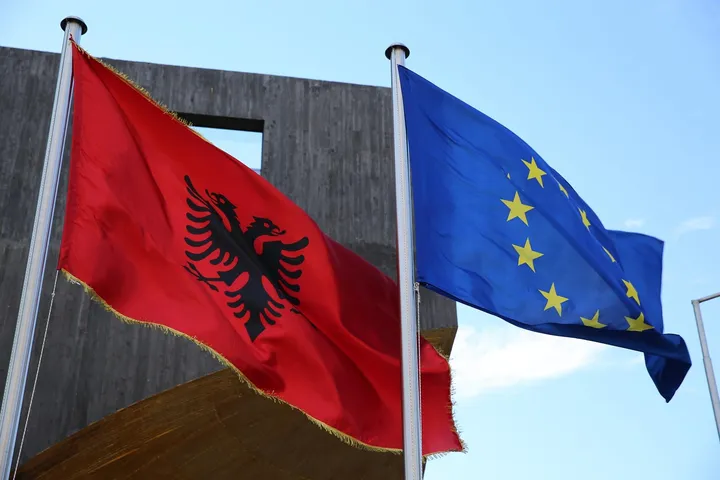
01Is crypto legal in Albania? The short answer
Yes. Nothing in Albanian law stops you from buying, holding, selling or gifting bitcoin, ether or USDT. A software developer in Tirana who buys €100 of bitcoin with a debit card breaks no rule. What Albanian law does regulate is the business side: companies that run exchanges, look after other people's coins or act as token agents.
The complication is that the licensing regime set up for those businesses has never actually worked. As of October 2026, the Financial Supervisory Authority (AMF, Autoriteti i Mbikëqyrjes Financiare) has licensed nobody. Every platform you use from Albania, from Binance to Kraken, is therefore foreign and, at best, supervised somewhere else. That includes CEX.IO, our pick for card purchases, which is not licensed by the AMF either, like every other platform.
The same logic answers the common question "is Binance legal in Albania?". Individuals are not barred from using it and Binance accepts Albanian residents, but it holds no Albanian licence, and European licences protect EEA customers rather than you. Platform-by-platform details are in our best crypto exchanges in Albania ranking and the Binance review.
02Law No. 66/2020: what Albania's crypto law says
Parliament passed Law No. 66/2020 "On Financial Markets Based on Distributed Ledger Technology" on 21 May 2020, by 88 votes to 16 with 3 abstentions. It entered into force on 1 September 2020. At the time it was billed as one of Europe's most comprehensive crypto laws, and the government was openly pitching Albania as a regional centre for innovative financial markets.
The law sorts digital tokens into payment, securities, service and asset tokens. It defines a virtual currency as a digital representation of value used as a means of exchange that is "not issued or guaranteed by a state body". Chapter IV also covers initial coin offerings and security token offerings.
Article 4 creates five licence types. A digital token (DT) agent is licensed by the AMF. A DLT exchange, centralised or decentralised, and a third-party wallet custodian need approval from both the AMF and AKSHI, the National Agency for Information Society. Innovative service providers and automated collective token investment undertakings are licensed by AKSHI alone. Exchanges come in categories A, B and C, depending on whether they trade only service, payment and asset tokens, add fiat and virtual currencies, or add security tokens on top.
The division of labour is tidy on paper: the AMF checks regulatory and compliance matters, AKSHI checks the technology. Capital requirements are steep for a small market: ALL 18 million for custodians, DT agents and innovative service providers, and between ALL 18 million and ALL 90 million for exchanges.
Implementing rules arrived slowly. The AMF board approved the first two regulations, on capital adequacy and on licensing DT agents, in November 2021. Parliament's economy committee then told the AMF and AKSHI to finish the rest within 2022, and the government says the framework was completed that year, including the AMF regulation on DLT exchanges of September 2022.
03Zero applications, zero licences
The single most important number comes from the government itself. Its final regulatory impact assessment (RIA) of 13 May 2026 records the monitoring indicator as "0 applications, 0 licensed entities". Not one licence application has reached the AMF or AKSHI under Law 66/2020.
Part of the reason is the law's own design. Every application, apart from the AKSHI-only categories, had to be screened and filed through a licensed DT agent. Nobody applied to become a DT agent, so nobody could apply for anything else. The government's document describes the result plainly: the licensing mechanism "has not become functional in practice".
It was not for lack of curiosity. Between 2021 and 2025 the AMF received about 45 email enquiries from private parties. The most common subject was DLT exchanges and token or virtual-currency exchange (15 enquiries), and there was strong interest in mining too. None of it turned into an application.
04Timeline of crypto regulation in Albania
From the central bank's first warning to the EU-aligned drafts, these are the dates that matter. The last entries are still in progress.
- 13 Jul 2017Bank of Albania warns about virtual currencies
No entity is licensed for the activity, and such firms sit outside its supervision.
- 17 Jun 2019Law 33/2019 brings virtual-asset providers into AML law
KYC, enhanced due diligence and suspicious-transaction reporting.
- 21 May 2020Parliament adopts Law 66/2020
88 for, 16 against, 3 abstentions. In force from 1 September 2020.
- Nov 2021 – 2022AMF approves the bylaws
Capital, DT-agent licensing and the DLT exchange regulation.
- Oct 2023Albania leaves the FATF grey list
It had been listed in February 2020.
- 1 Jan 2024Income tax Law 29/2023 takes effect
15% on individuals’ crypto gains.
- 27 Nov 2025 – 30 Jan 2026Public consultation on the MiCA-style draft
1,631 visits, 0 comments.
- 13 May 2026Final RIA: 0 applications, 0 licences
Stated goal: full MiCA alignment within 2026.
- 7 Jul 2026DAC8 draft on crypto tax-information exchange
Platforms would report customer data to the tax authority.
- 29 Jul 2026New draft AML law with the travel rule
Status: draft.
05The draft law "On Markets in Crypto-Assets"
With the 2020 law stuck, the government chose to replace it. On 31 July 2025, Prime Minister's Order No. 108 set up an inter-institutional working group led by the Ministry of Economy and Innovation, with the AMF, the Bank of Albania, the Ministry of Finance, AKSHI, the Financial Intelligence Agency and the National Cyber Security Authority. Its job: fully transpose Regulation (EU) 2023/1114, better known as MiCA, as part of Albania's Chapter 9 (financial services) accession work.
The bill, "Për tregjet e kripto-aseteve", was open for public consultation from 27 November 2025 to 30 January 2026. The portal logged 1,631 visits and not a single comment. The explanatory report and the final RIA describe a very different system from the 2020 one:
- The AMF would authorise and supervise every crypto-asset service provider (CASP): trading platforms, exchange, custody, transfers, order execution, advice and portfolio management.
- The Bank of Albania would authorise issuers of asset-referenced tokens (ARTs) and supervise issuers of e-money tokens (EMTs), in other words stablecoins. AKSHI drops out as a regulator.
- Firms would apply directly, with no DT-agent gateway. MiCA-style capital, up to €150,000 for trading platforms, is lower than today's thresholds.
- White-paper, marketing and market-abuse rules would apply, with fines of up to €5 million or €15 million and a three-year AMF regulatory sandbox.
- Article 141 would repeal Law 66/2020 and its bylaws. DeFi and fully decentralised exchanges stay outside the perimeter.
Has it been adopted? As of October 2026 we found no evidence that the Council of Ministers has approved it or that Parliament has voted on it. The draft's entry-into-force date, "1 March 2025", had already passed when the explanatory report was written, so it is plainly a placeholder. Until adoption, Law 66/2020 is the law in force and the MiCA-style bill is a draft. We will update this page when that changes.
06The Bank of Albania: a warning, not a ban
The central bank's main public position is still its warning of 13 July 2017. It said the legal framework did not provide for this activity in Albania, that no financial entity was licensed for virtual currencies, and that such firms were outside its supervision. It listed volatility, unregulated exchanges, cyber risk, the absence of deposit insurance and money-laundering abuse, and advised the public to stick to products from institutions it licenses.
A warning is not a prohibition. We found no later Bank of Albania regulation forbidding banks to serve customers who buy crypto, although in practice your bank may ask for source-of-funds documents when money arrives from an exchange. The practical side is covered in how to sell crypto and cash out in Albania.
On a "digital lek", the Bank of Albania is at the research stage only. It has published work on central bank digital currencies, and Governor Gent Sejko stressed a cautious, EU-aligned approach in 2026. No pilot has been announced.
The wider backdrop is euroisation. Slightly more than half of bank deposits and loans in Albania are in euros, and the central bank is running a strategy to bring that share down. Against that background, a private currency such as bitcoin, or a dollar stablecoin, is something the central bank views with reserve rather than enthusiasm.
07Anti-money laundering: from 2019 to the travel rule
Crypto entered Albania's anti-money-laundering law before the country had a crypto market law at all. Law No. 33/2019, adopted on 17 June 2019, amended Law No. 9917/2008 and introduced definitions of virtual assets and virtual-asset service providers (VASPs). Since then, VASPs carry the same duties as other financial entities: customer identification, enhanced due diligence, collecting data on crypto transfers and reporting suspicious transactions.
A VASP is anyone who, on behalf of others, exchanges virtual assets for fiat money or for property worth over ALL 1,000,000, swaps one virtual asset for another, transfers or safekeeps them, or takes part in issuer offers. Put simply, an exchange office selling USDT for lek is a VASP, and would need a Law 66/2020 licence that nobody holds.
The international scorecard is middling. MONEYVAL, the Council of Europe's evaluation body, rates Albania "partially compliant" with FATF Recommendation 15 on new technologies and virtual assets. It points to an incomplete risk assessment of VASPs, uncertainty over whether licensing covers all of them, and unclear supervisory responsibilities. Albania was removed from the FATF grey list in October 2023, having been added in February 2020.
Next comes the draft AML/CFT law of 29 July 2026, published by the Financial Intelligence Agency. It brings in the travel rule, so originator and beneficiary data must accompany crypto transfers, with fines from ALL 200,000 to ALL 10,000,000 for repeated failures. It also lets the agency freeze crypto-asset accounts. This, too, is still a draft.
08AMF warnings and police referrals
Despite licensing nobody, the AMF has not been idle. Its public line is that it has not licensed or authorised anyone to distribute, trade or store digital tokens or virtual currencies, and that anyone offering those services in Albania needs a licence. Its warnings section has named platforms such as TXEX, XUEXA and GROKREXDUU, unlicensed apps selling fake crypto "buy signals", and it has republished the joint warning of the European supervisory authorities on crypto-asset risks.
Between 2021 and 2025 the AMF referred more than ten entities to the State Police for carrying out Law 66/2020 activities without a licence. In November 2024 the police and prosecutors wrapped up a months-long operation: 32 entities investigated and 18 criminally prosecuted, including six licensed foreign-exchange bureaux. The message is clear. Buying crypto for yourself is fine; selling crypto exchange services to the public without a licence can land you in court.
09Can you pay with, or accept, crypto?
Crypto is not legal tender in Albania. No law authorises it as a means of payment, but we also found no rule that expressly forbids a merchant from accepting bitcoin by mutual agreement. It is a grey zone. In practice acceptance is rare: OpenStreetMap lists just four places in the whole country, mostly hostels and holiday flats in Shkodër, Golem and Sarandë, with data from 2024.
Take particular care with property. Some portals advertise flats with "crypto payment", but the notary and the land registry work in lek or euros, and banks run AML checks on crypto-sourced money. A business that exchanges crypto for its customers falls under the VASP definition. If you run a business and are thinking of accepting crypto, speak to a lawyer and your accountant first.
10Tax, mining and scams in brief
Tax. Since 1 January 2024, Law 29/2023 taxes individuals' gains from virtual-asset transactions and from mining at 15% as investment income, unless the activity counts as a business. You declare it yourself, by 31 March of the following year. How to work out the gain and which records to keep is explained in our guide to crypto tax in Albania.
Mining. According to the government, mining is not regulated as a financial service, and we found no ban. The police cases in Fier, Shijak and Shkodër were about stolen electricity, not mining itself. Legal status and practical risks are covered on is crypto mining legal in Albania.
Scams. The absence of local licences suits fraudsters, because anyone can claim to be "regulated". The Tirana call centres shut down with Eurojust's support in April 2026, after losses of over €50 million, are the biggest example. How to check a platform and where to report is on our crypto scams in Albania page.
11What Albania's crypto law means for you
For an ordinary user, Albanian law today has three practical consequences. First, you are free to buy and hold crypto. Second, there is no Albanian authority to protect you if a platform goes bust, freezes your account or defrauds you. Third, you owe tax on gains, even though nobody withholds it for you.
That puts the burden on you. Choose large platforms with a long track record, check their list of excluded countries, and ignore claims of an "Albanian licence". Keep a record of every purchase and sale. For larger sums, don't leave coins on an exchange for months; learn how a self-custody crypto wallet works.
This page is for information only and is not legal advice. For specific situations, such as setting up a crypto business or a large property deal, consult a lawyer licensed in Albania.
Frequently asked questions
Is crypto legal in Albania?
Yes. No Albanian law stops individuals from buying, holding or selling bitcoin and other crypto-assets. Law No. 66/2020, in force since 1 September 2020, regulates companies that provide crypto services, not private users. However, as of October 2026 no company has been licensed by the AMF under that law, so local investor protection is minimal.
Is Binance legal in Albania?
Using Binance is not prohibited for individuals, and Binance accepts Albanian residents. It does not hold an AMF licence under Law 66/2020 (no platform does), and any European licence it holds covers EEA customers rather than Albanian ones. In practice that means there is no Albanian authority to complain to if something goes wrong with your account.
Is bitcoin legal tender in Albania?
No. The Albanian lek (ALL), issued by the Bank of Albania, is the only legal tender. Law 66/2020 defines a virtual currency as a digital representation of value that is not issued or guaranteed by a state body. Nobody is obliged to accept bitcoin as payment, and no law authorises crypto as a means of payment.
Has Albania adopted a MiCA law?
Not as far as we could confirm. The draft law "On Markets in Crypto-Assets" went through public consultation from 27 November 2025 to 30 January 2026, and the final impact assessment is dated 13 May 2026. We found no evidence of Council of Ministers approval or a parliamentary vote by October 2026, so Law 66/2020 remains the law in force.
Is crypto trading legal in Albania?
Trading your own crypto on an international exchange is legal for individuals, and gains are taxed at 15% under Law 29/2023. What requires a licence is offering exchange, custody or transfer services to other people as a business. Nobody holds such a licence, and the police have prosecuted unlicensed operators, including foreign-exchange bureaux, in 2024.
Sources
- Final RIA, draft law “On Markets in Crypto-Assets”, 13 May 2026 · checked Oct 2026
- Explanatory report, draft law on crypto-asset markets, 18 Nov 2025 · checked Oct 2026
- Draft AML/CFT law, 29 July 2026 (Financial Intelligence Agency) · checked Oct 2026
- AMF warning on TXEX, XUEXA, GROKREXDUU and similar platforms · checked Oct 2026
Ready for your first coin?
Sign-up and the ID check take a few minutes. Then you can buy Bitcoin, Ether or USDT with your Visa or Mastercard.
No crypto platform is licensed by Albania’s AMF yet — this one included.